Ready, Set, Go! All programs begin September 8th! Click to learn more:

Programs

RAPTOR

Tue 4:00 – 6:00 PM Fri 6:00 – 8:00 PM

Apply

Robotics & Autonomous Platforms for Tournaments, Optimization, & Research

RAPTOR is IEEE at USF’s autonomous vehicle competition team. Members design, build, and field a complete autonomous platform and compete in the RTX Autonomous Vehicle Competition (RTX AVC). The competition is organized regionally, and RAPTOR competes in the Southeast.

The team forms each September and competes in April, working out of the IEEE at USF Lab in ENG 208. The 2026–2027 season is Mission Bird Dog: an indoor, GPS-denied search-and-retrieve challenge built around natural-language command, edge AI, and collaborative autonomy.

What Students Learn

  • GPS-denied indoor navigation and target identification
  • Natural-language command, edge AI, and computer vision
  • Embedded systems, sensors, wireless, and power
  • Requirements, design reviews, and full vehicle integration

Goals for the Year

  • Compete for 1st place at RTX AVC Mission Bird Dog
  • Field a system that follows Leader’s Intent on the edge
  • Integrate BrainChip neuromorphic AI and NFC target ID
  • Train juniors to lead next season

2026–2027 Timeline

RAPTOR follows the Raytheon AVC semester cycle from September kickoff through the April regional event.

Phase Focus Expected Output
September Kickoff Rules review, roster, roles, and system requirements review.
October Proposal Design review complete and parts ordered.
December Prototype Mid-year / CDR report and prototype demonstration.
January–March Integration and test AVC demos 1–3 and indoor GPS-denied verification.
April RTX AVC Fielded autonomous system at the regional competition.

2026–2027 season

Mission Bird Dog

RTX Autonomous Vehicle Competition — Southern Region

This year’s challenge is indoor and GPS-denied. Teams field an autonomous vehicle system with at least one UAV or UGV — with no limit on how many vehicles they use — then follow Leader’s Intent given in natural language, by voice or text. All processing stays on the vehicle, at the edge.

The system must find a designated target among colored objects, read a secret NFC message from it, and send that message back to the leader. Physically returning the target to the starting zone is a bonus. Judges can change the target during a run. Each challenge has a 7-minute limit.

Competition Challenges

  1. Challenge 1 — Base Bird Dog: Navigate to the assigned target, recover the NFC message, and return it to the leader.
  2. Challenge 2 — Congested Bird Dog: Same mission through a field of 3D obstacles such as boxes, cones, and buckets.
  3. Challenge 3 — Replan Bird Dog: The target changes mid-run. The system has to replan and finish on the new object.

Season Constraints

Field and targets

  • Indoor field, about 15 yd × 15 yd
  • GPS is not allowed
  • Targets are 6-inch foam dice in blue, red, yellow, or black
  • Start/return zone is a 5 ft square; the full system has to fit inside it

Autonomy and hardware

  • Natural-language Leader’s Intent via microphone or chat
  • BrainChip neuromorphic AI is required on the system
  • Kill switches required; UAV propeller guards required
  • $5,000 baseline budget, with additional fundraising allowed

Summary of Raytheon AVC Rules v0.3 for Fall 2026–Spring 2027. Official details can still change. Team members should work from the current packet provided by RAPTOR leads and Raytheon mentors.

Last season

2025–2026 Result

Operation Touchdown — RTX AVC Southeast Regional

2nd Place Coordinated UAV–UGV system for autonomous navigation, target detection, and task execution
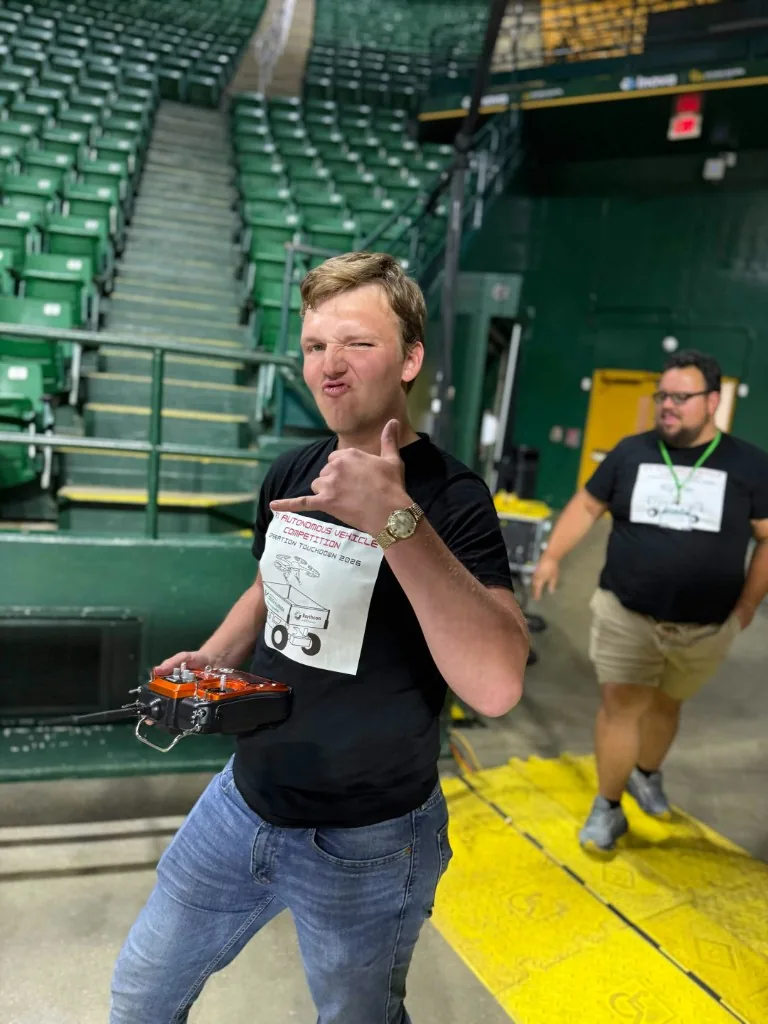
RAPTOR team member holding the second-place RTX Autonomous Vehicle Competition award
RAPTOR earned second place at the RTX Autonomous Vehicle Competition.

Competition Challenge

Teams built a coordinated UAV–UGV platform and competed across three progressively harder rounds.

  1. Round 1: UAV takeoff, straight-line flight, and landing on the UGV
  2. Round 2: ArUco marker detection and coordinated UGV transport
  3. Round 3: Obstacle detection and avoidance during flight

How the Team Approached It

  • Split work across UAV/UGV hardware, software, and sensor integration
  • Validated each subsystem independently before full integration
  • Standardized vehicle communication with MAVLink
  • Tested incrementally, from single-system checks to full multi-level runs

Platform Design

UGV

Mobile landing and transport platform for GPS-denied coordination with the UAV.

  • Traxxas 1/10-scale crawler chassis with custom 3D-printed mounts
  • Raspberry Pi 5 for navigation and coordination
  • Cube Orange+ with ArduPilot for low-level control
  • UWB positioning, ultrasonic sensing, encoders, and ArUco camera tracking

Also used: Holybro SiK Telemetry Radio V3, 6S LiPo, AKD1000 M.2 card, DroneCAN RM3100 compass

UAV

Flight platform focused on precise relative positioning and reliable UGV landing.

  • Raspberry Pi 5 for navigation, vision, and coordination
  • Cube Orange+ with ArduPilot for flight control and sensor fusion
  • UWB localization for centimeter-level GPS-denied positioning
  • OpenCV ArUco detection and closed-loop precision landing

Also used: Tarot Iron Man 650 frame, MicroAir P1 Optical Flow, T-Motor MN-4006 380kV, Radiolink AT10II, Holybro SiK Telemetry Radio V3, 6S LiPo

Key Takeaways

  • UWB localization enabled stable relative positioning without GPS
  • Modular design and early testing helped catch perception, communication, and landing issues
  • The integrated UAV–UGV system demonstrated reliable autonomous coordination

Team

Leadership

  • UAV Lead: Matthew Moore
  • UGV Lead: Elijah Korostishevski

Hardware & Software

  • UAV HW: Ernesto Rodriguez
  • UGV HW: Ryan Leigh
  • UAV SW: Nathan Frost
  • UGV SW: Adler Montero Padilla
  • HW Support: Adrian Gonzalez

Support

  • Documentation: Karina Burns
  • AI Implementation: Zoe Mutiu

Advisors

  • Chung Seop Jeong | USF Faculty
  • Chris Ferekides | USF Faculty
  • Jay Schroder | RTX Advisor
  • Sylvia Traxler | RTX Advisor